US$2bn across eight companies, announced at a roundtable at The White House on Friday.
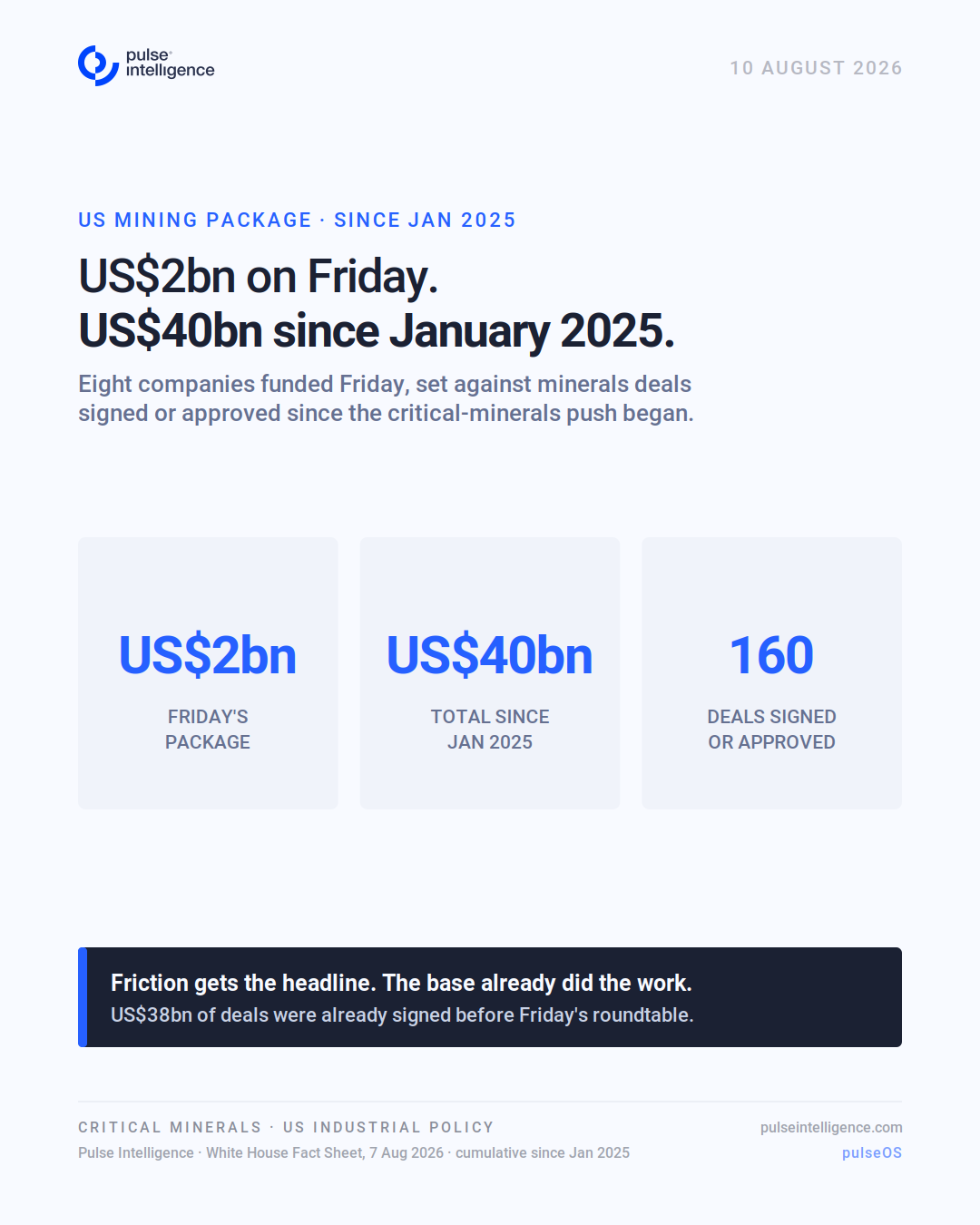
Set against the running total, that is the small number. The same fact sheet confirms 160 minerals deals worth close to US$40bn signed or approved since January 2025.
Friday's package breaks down like this. US$1.4bn to Sila Nanotechnologies, Inc. for silicon-carbon battery anodes. US$400m to Sunrise Energy Metals for scandium. US$150m to Niron Magnetics, Inc. for rare-earth-free permanent magnets. US$85m to Standard Bauxite for refractory-grade bauxite. Then four smaller cheques: US$25m each to Westwater Resources for Alabama graphite and Global Advanced Metals for tantalum and niobium, US$8m to 5E Advanced Materials, Inc. for boron, and US$4.8m matched into Harena Rare Earths Plc in Madagascar.
Separately, US$180m into America's mining schools.
Two agencies are doing the work. The United States Department of War, through its Office of Strategic Capital, is writing the large cheques. The Export-Import Bank of the United States is writing the small ones.
The commodity list is made up of bauxite, scandium, boron, tantalum, niobium, graphite, rare earths. Not one of them trades on a liquid exchange. Not one has a published forward curve. Every single one is priced by negotiation between a handful of counterparties.
Washington has worked out that the commodities you cannot hedge are the ones you have to own.
Most of the sector is still reading this as a subsidy story. It is a supply chain map, drawn in public, by the largest buyer in the world.
Less searching. More strategising.™
Where does your team's data infrastructure sit today?
Answer 10 questions. Get a private diagnostic on your AI readiness, in minutes.
Less Searching. More Strategising.™
See the platform running on real mining data, and what it would look like for your team.