China's share of rare earth mining has fallen to roughly 58%. Its share of refining has barely moved off 91%. Nobody had counted what sits on both sides of that gap, asset by asset, until now.
Free download below.
Pulse Intelligence · Free edition, 1 September 2026
Objective
On 6 January 2026, China's Ministry of Commerce placed dual-use export restrictions on Japan covering rare earths, permanent magnets, gallium, germanium, graphite and antimony, effective immediately. Between November 2025 and June 2026, Chinese customs recorded zero exports of dysprosium and terbium oxide to Japan. Eight weeks after suspending an equivalent ban on the United States, Beijing opened a country-specific one against a G7 ally that hosts the largest rare earth magnet industry outside China.
That is a targeting capability, demonstrated at named-company level. It leaves one question for every procurement officer, defence prime, policy team and corporate development desk: who can credibly supply rare earths from outside China, and when? DFARS Section 4872 puts a date on it, restricting China-, Russia-, Iran- and North Korea-connected magnets in US defence procurement from 1 January 2027.
Nobody had published that answer at asset level. We did.
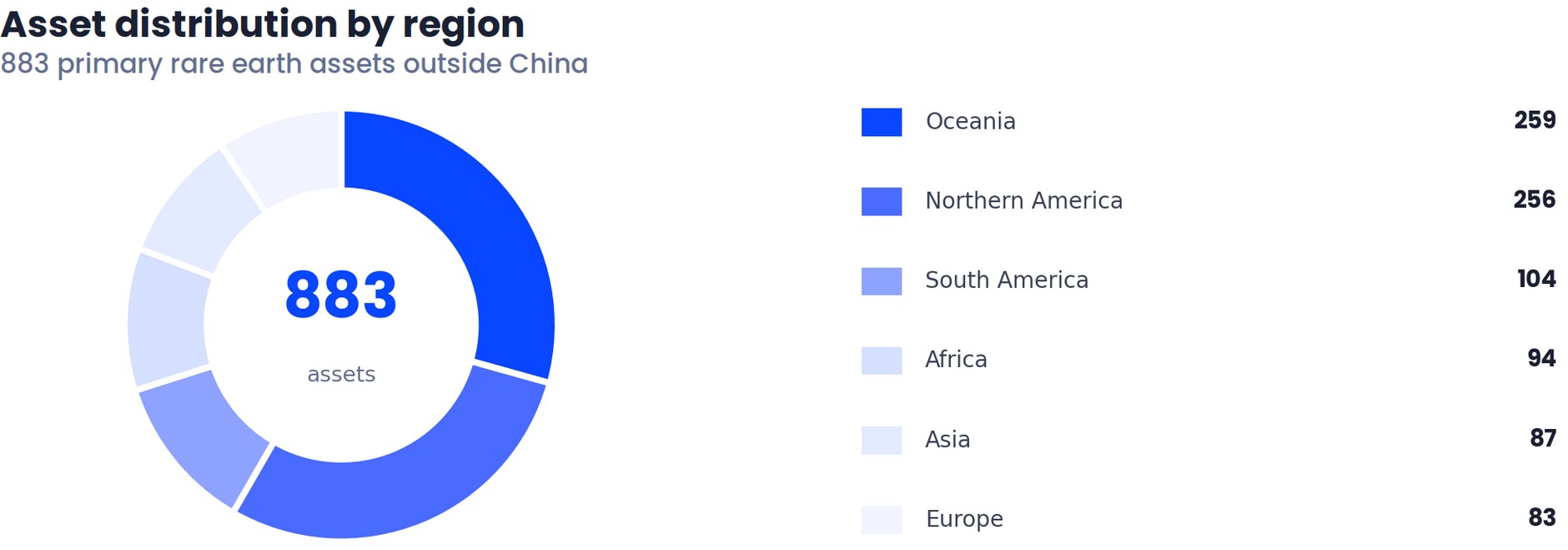
The Rare Earths Global Supply Register is every mining asset and processing facility carrying rare earths, worldwide, on both sides of the Chinese chokepoint, counted, staged and sourced. It's Volume 2 of the Pulse critical minerals series, following Tungsten outside China. The full report is a free PDF.
What's inside
2,126 assets · 981 primary · 17 separation plants outside China · seven operating mines: the count nobody had run at asset level, with its sources attached.
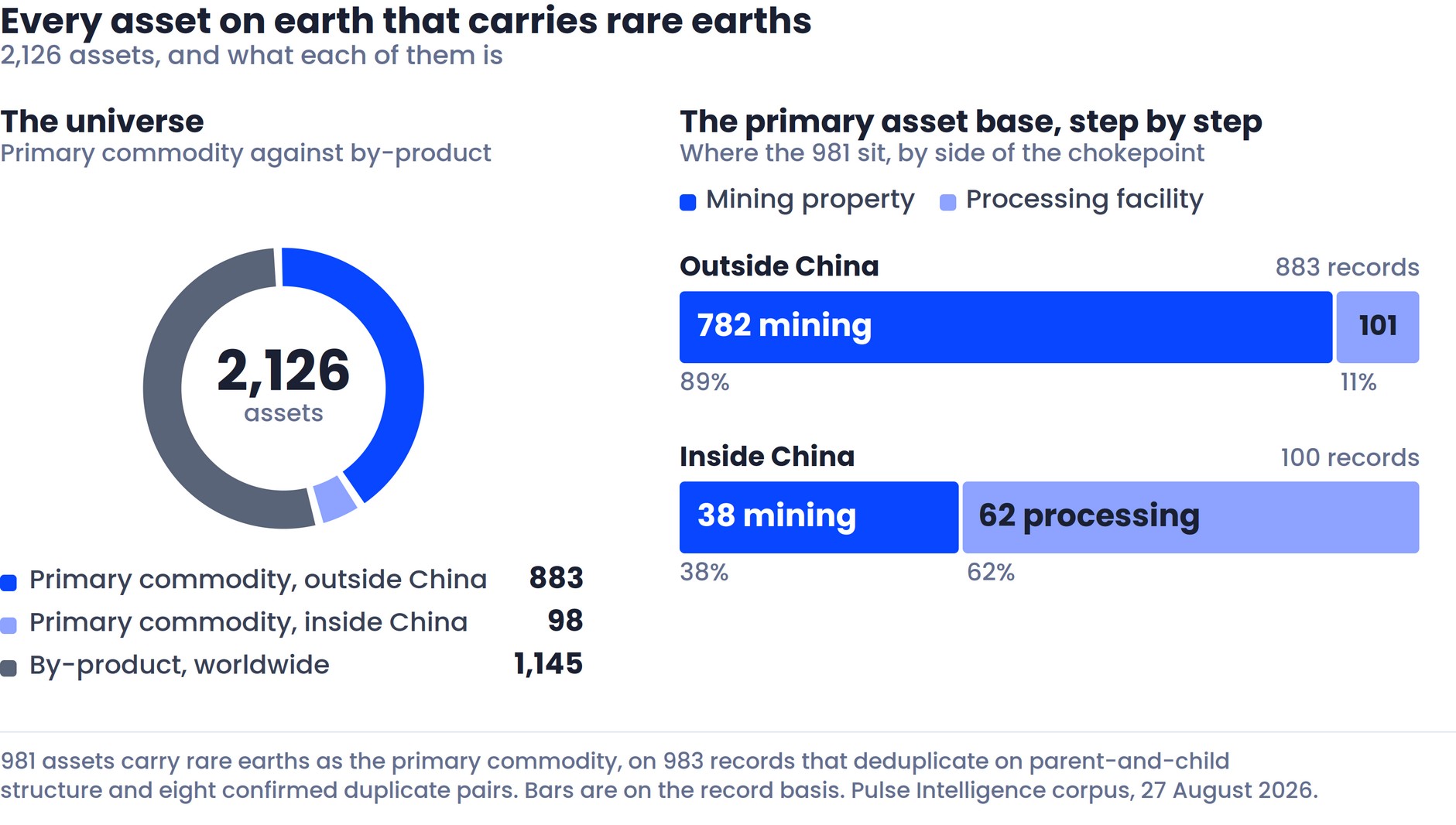
- The full universe, split two ways. 981 assets carry rare earths as the primary commodity: 883 outside China, 98 inside it. A further 1,145 carry rare earths as a secondary or by-product metal, and are frequently the better acquisition target, because another commodity has already paid for the pit, the plant and the permits.
- Mining diversified. Refining didn't. China's share of light rare earth mining fell from roughly 97% in 2010 to roughly 58% by 2024. Its share of separation and refining has stayed at 91%, and its share of sintered permanent magnets at 94%. Every step of the chain is more concentrated than the one before it, and the mine is the least concentrated of all.
- Seventeen plants, one of them at scale. Commercial separation capacity outside China, against 42 inside it. Eight of the 17 aren't available to a Western buyer at all: three in India, three in Vietnam, one in North Korea, one in Russia.
- Seven producing mines, two of them not really mines. Built on the operating record rather than the phase label: two of the seven sit in informal artisanal districts in Myanmar with no corporate operator to name, and two more ex-China tonnes flow to Chinese owners or Chinese separation regardless.
- The 31% China's own numbers hide. By USGS's own footnotes, roughly a third of ex-China mine supply can't be tied to a producing asset in any dataset. It's estimated from Chinese import data, not measured at the mine.
- One asset, all ten data layers. A worked example, Browns Range in Western Australia, taken through identity, ownership, geology, milestones, permits, studies, reserves and drilling, sourced to 532 linked filings.
- Fully sourced, never averaged. IEA, USGS Mineral Commodity Summaries 2026, IMF and issuer filings, each cited on its own basis. Where a figure couldn't be reconciled, it's excluded or flagged, not blended into a number that hides the disagreement.
- Format: 30 pages, free edition.
Seven mines, on the record
| Mine | Country | Holder | Status |
|---|---|---|---|
| Mt Weld | Australia | Lynas Rare Earths | Producing since 2011 |
| Pela Ema (Serra Verde) | Brazil | Serra Verde Group | Producing since Jan 2024 |
| Mountain Pass | United States | MP Materials | Producing since 2012 |
| Lovozero | Russia | Rosatom | Producing, not available to Western buyers |
| Pangwa | Myanmar | Unattributed | Informal district, no corporate operator |
| Mong Yawn | Myanmar | Chixia Mining (Laos) | Informal district, no corporate operator |
| Thap Peng North 2 | Laos | Laos-China Rare Mineral Dev. | Producing, Chinese-owned |
Only five of the seven have a company you could actually call. The other two are informal artisanal districts. One is administered by an armed opposition group rather than any corporate operator. That's the read-the-record discipline this register applies to every one of 2,126 rows, not just the seven above.
Get the register, free
Enter your email and we'll send the PDF straight over. No login, no sales call, just the count.
The paid edition
This is the free edition. The paid edition covers all 2,126 assets in detail: 883 ex-China and 98 Chinese primary-commodity assets, plus the full by-product annex of more than 1,000 additional assets. Each row carries holder, stage, status, milestones and permits, alongside a workbook and a verification ledger.
All 2,126 assets, every holder, every source.
Credits in full against a first-year Pulse Intelligence subscription, one credit per organisation, used within 90 days of purchase. Includes the January 2027 re-cut, after DFARS Section 4872 takes effect, at no further cost.
Less searching. More strategising.™
Asset counts, ownership, stage, status, study data and document volumes: Pulse Intelligence corpus as at 27 August 2026. Counts reflect assets where rare earths are the primary commodity unless stated otherwise. Sources outside the corpus, cited as such in the full register: USGS Mineral Commodity Summaries 2026; the IEA; the IMF; and the filings of the issuers named, each on its own basis and date. Milestone and study gates are not comparable between Chinese and ex-China rows and are not charted for China, which does not file JORC or NI 43-101 disclosure. This document is public and not investment advice; the underlying data may not be extracted, redistributed or resold without written consent.
Where does your team's data infrastructure sit today?
Answer 10 questions. Get a private diagnostic on your AI readiness, in minutes.